Rules
Playing the Dark Arts side
Data last checked: · how we verify numbers
Every game of Defenders of Hogwarts has exactly one Dark Arts Player — one seat, facing 1–4 House Players, with their own board, their own decks and the game’s only asymmetric role [official, p. 3]. They have no Learn action, they never discard, their pawns cross every barrier on the map, and they win by collecting all 3 Dark Arts Progress Tokens and landing 3, 2 or 1 pawns on a single location [official, p. 12, p. 20–21]. The rulebook suggests giving the seat to the most rules-experienced player at the table.
Everything sits in the base box
Nothing about the Dark Arts side is an expansion. The base game includes their player board, a 7-card Starter Deck, a 20-card Acquire Deck, a 4-card Dark Arts Player Location Deck, and 4–7 pawns depending on the House Player count — 4 deployed onto the board’s Deployment Spaces at setup, any extras waiting in the pool beside the player [official, p. 4, p. 6, p. 8]. The three Event decks — white, orange and red, 5 cards each — are split and shuffled beside the Dark Arts Player’s board, and they draw an opening hand of 5 just like everyone else [official, p. 8].
The 7 starter cards, named
All four House starter decks are identical; the Dark Arts starter deck is nothing like them [official, p. 13]. Every card below was read from the printed cards illustrated in the official rulebook [official, decoded from rulebook renderings]:
| Card | Movement | Effect |
|---|---|---|
| Conspire | 3 | Draw 1 card, discard 1 card, deploy 1 Dark Arts Pawn. The starter deck’s only effect — and the only starter card that can put a pawn on the board. |
| Conspire | 4 | No effect. A separate card from the 3-value Conspire, not a copy of it. |
| Nimbus 2001 | 2 | Your pawn can move from a Fly Off Point to any other Fly Off Point. |
| Gathering Dark Forces | 3 + 3 | No effect. Multi-move: two pawns 3 spaces each, or one pawn up to 6. |
| Gathering Dark Forces | 2 + 2 | No effect. The second multi-move card, at the smaller split. |
| Legilimency | 4 | No effect. |
| Legilimency | 5 | No effect. The starter deck’s longest single move. |
Six of the seven are pure movement — the deck’s early game is about position, and its engine arrives later through bumps and zone-unlocked effects [our analysis, from the official card list]. Once the Acquire Deck opens up, cards follow the same shape: the rulebook’s illustrated example, Peruvian Instant Darkness Powder, carries a white-zone effect and a Fly Off Point movement icon [official, decoded from rulebook renderings].
Your turn: Explore or Replenish
The Dark Arts Player takes exactly one Main Action per turn, and the menu is shorter than the House Players’: Explore or Replenish — there is no Learn action, no Free Actions, and Bonus Spaces never trigger for Dark Arts pawns [official, p. 16, p. 20–21].
Explore works exactly as it does for House Players — play 1 card and resolve its move and/or effect in whichever order you choose, resolving the first card fully before any card its effect chains [official, p. 20–21]. The difference is freedom of movement: Dark Arts pawns move through all four barrier types — locked doors, protective spells, physical objects and water — without any card help, while castle walls stay impassable, the 4 Protected Areas can never be entered, and Secret Passageways are House Players only [official, p. 10, p. 20].
Two Explore rules are Dark-Arts-specific:
- Deploying from the pool. Bringing an off-board pawn into play costs 1 movement point and places it on 1 available Deployment Space — the spaces marked with the Dark Mask icon [official, p. 20].
- Deployment Spaces are exclusive. You cannot deploy onto a Deployment Space that already holds a Dark Arts pawn, including a stunned one [official, p. 20].
Replenish is two steps: stand up all your stunned pawns, then draw to a 5-card hand [official, p. 21]. It does not advance the Dark Arts Marker, and — the rulebook is blunt about this — you can never discard during it: only House Players can discard cards before drawing [official, p. 12, p. 21].
Common mistake
Trading cards during your Replenish the way House Players do. The rulebook reserves discarding for House Players only [official, p. 12, p. 21] — the Dark Arts hand is what it is until a bump’s card draw improves the top of the deck.
Card effects unlock as the marker advances
Every Dark Arts card carries a colour indicator — white, orange or red — beside its name, and that colour is the key to its effect [official, p. 21]:
- White effects are unlocked from the very start of the game.
- Orange effects unlock once the Dark Arts Marker reaches the path’s first orange space — and stay unlocked for the rest of the game.
- Red effects unlock the same way at the first red space, stacking on top of everything before.
If the marker has not reached a card’s zone, the effect is simply ignored when the card is played — the movement value still works. Unlocked effects resolve before or after the card’s move, your choice [official, p. 21]. This is the Dark Arts Player’s power curve: their deck literally levels up as the path advances, so protecting the marker’s progress is protecting your own engine. The path’s triggers, zones and event flow are covered in the Dark Arts Path, 3 zones.
Bump: sending a defender home
When a Dark Arts pawn ends its movement on a space holding a House pawn, that is a bump — and it resolves in four steps [official, p. 21]:
- If the space holds more than one House pawn, the Dark Arts Player chooses which one is bumped.
- The bumped House pawn goes back to the Great Hall; the bumping Dark Arts pawn returns to the pool, off the board.
- The Dark Arts Player takes that player’s House Marker (if not already held). The moment they hold every House Marker, the Dark Arts Marker immediately advances 1 space along the path — then all House Markers return to their owners.
- The Dark Arts Player draws the top 2 cards of their Acquire Deck, chooses 1 to place on top of their Draw Deck, and puts the other back under the Acquire Deck. This draw happens once per turn, even after several bumps.
Note what the bump costs you, the attacker: your pawn leaves the board and must be redeployed for another movement point later. A pawn standing inside a Protected Area cannot be bumped at all [official, p. 20].
Common mistake
Bumping the same player over and over. Once you hold someone’s House Marker, bumping them again earns nothing extra — the path advance only triggers when you hold the full set, and the card draw is capped at once per turn [official, p. 21]. Spread the bumps.
Getting stunned: the mirror image
The reverse collision is a different mechanism with a different outcome. When a House Player pawn ends its movement on your pawn’s space, both pawns are stunned — laid sideways on the board — and the House Player decides which adjacent space your stunned pawn is moved to [official, p. 16].
Stunned pawns cannot move in any way, by card movement or card effect, and they stay down until their owner stands them up during a Replenish — your Replenish’s step 1 exists precisely for this [official, p. 16, p. 21]. Your stunned pawn also still occupies its space, which keeps the Deployment Space beneath or beside it off-limits to fresh deployments [official, p. 20].
| Scenario | What happens | Who decides the outcome |
|---|---|---|
| Dark Arts pawn ends its move on a House pawn (bump) | House pawn to the Great Hall; Dark Arts pawn to the pool; House Marker changes hands; 2-choose-1 Acquire Deck draw, once per turn. | Dark Arts Player |
| House pawn ends its move on a Dark Arts pawn (stun) | Both pawns lie stunned where the collision happened; neither moves until Replenish stands them up. | House Player picks the adjacent space your pawn is moved to |
Reviews sometimes use “bump” for both collisions — One Board Family’s write-up calls the stun case a bump too — but the official rulebook keeps the two words apart, and the outcomes only work if you do as well [official, p. 16, p. 21].
Winning as the Dark Arts Player
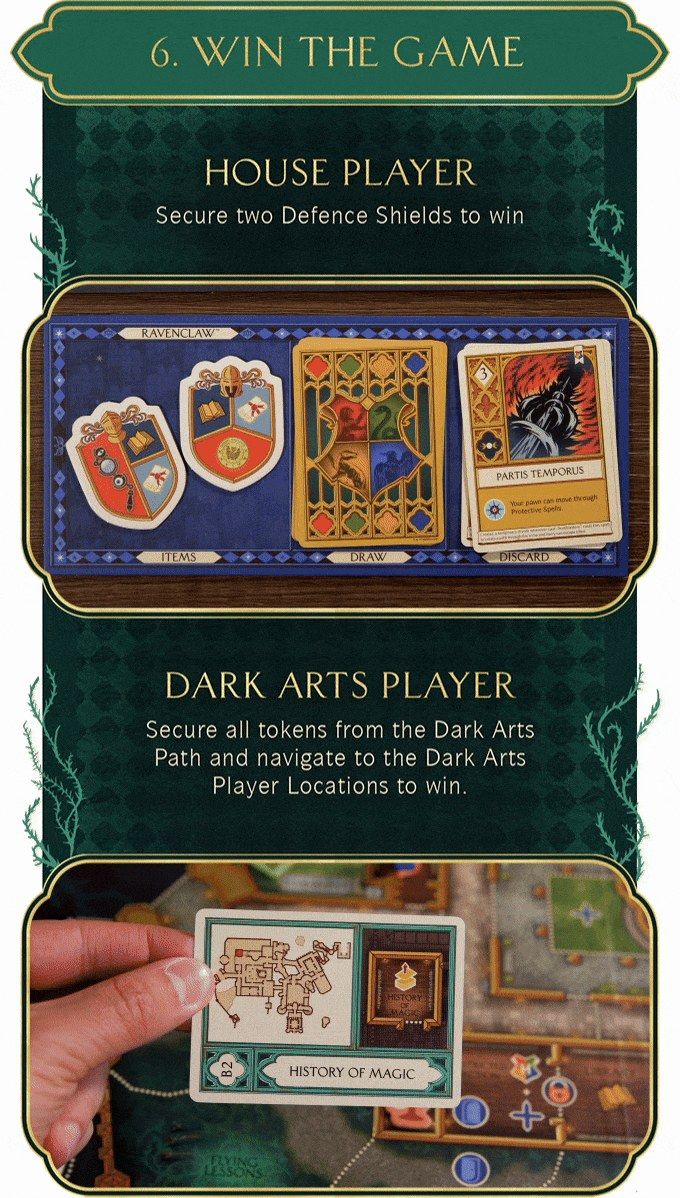
The win is two conditions at once [official, p. 5, p. 23]: hold all 3 Progress Tokens — Giant from white, Acromantula from orange, Dementor from red — and have the required number of pawns standing on the Dark Arts Player Location at the same moment. That count is fixed by where in the red zone the Location Card was taken: 3 pawns at the first Red Event Space, 2 at a later one, and just 1 if the card is only taken on the path’s last space, where taking it is mandatory [official, p. 22]. The zone-by-zone mechanics behind this live in the Dark Arts Path, 3 zones.
Beyond movement and bumps, the deck carries direct pressure: the rulebook’s glossary confirms a Confundo card can force a House Player to skip their turn entirely, and BoardGameGeek users count at least two such cards across the Dark Arts decks [official] [BGG user data].
Warning
The difficulty of the whole table rests on this player. One Board Family’s published review concluded that “the game difficulty is really set by the Dark Arts player,” listing “difficulty will rely heavily on the gameplay of the Dark Arts player” among its lows (One Board Family review). A timid Dark Arts player deflates the race for everyone; a skilled one makes four houses sweat. Play to pressure — bumps, markers, events — not to turtle.
Watch the Dark Arts explained
Chapter deep links into the official MinaLima how-to-play video (timestamps verified against the video’s chapter markers on 2026-10-13):
Sources
Official rulebook PDF, MinaLima — faction overview p. 3, set up p. 4–8, discard rule p. 12, starter card illustrations p. 13, stun p. 16, movement p. 10 and p. 20, Dark Arts turn and bump p. 20–21, path and end game p. 22–23, glossary p. 25–29: media.minalima.com — Defenders of Hogwarts rulebook. Review quotes: One Board Family, “Defenders of Hogwarts Review”. Turn-skip card count: BGG thread 3732990.