Rules
The Dark Arts Path, 3 zones
Data last checked: · how we verify numbers
The Dark Arts Path is the three-colour track on the side board that paces the whole game. Every House Player Replenish advances the Dark Arts Marker one space along it, Event Spaces trigger Event cards as it passes, and the Dark Arts Player wins by collecting all 3 Progress Tokens from the three zones and landing the required number of pawns on one final location [official, p. 22].
Three zones, three Progress Tokens
The side board sits above the main board and carries two tracks: the Hogwarts Loyalty Track and the Dark Arts Path [official, p. 7]. The Dark Arts Marker starts on the path’s first space, and the 3 Dark Arts Progress Tokens — Giant, Acromantula and Dementor — wait on their own spaces inside the white, orange and red zones respectively [official, p. 7, p. 25–29].
| Zone | Progress Token | Event cards | What changes here |
|---|---|---|---|
| White (first) | Giant | White deck of 5 | Live from the start. Some white events are even positive for the House Players, but most event effects are negative [official, p. 22]. |
| Orange (second) | Acromantula | Orange deck of 5 | Dark Arts card effects with an orange indicator unlock when the marker reaches the zone, and events bite harder [official, p. 21–22]. |
| Red (last) | Dementor | Red deck of 5 | The endgame zone: the Dark Arts Player Location Card is taken here, and the fewer red Event Spaces you spend, the fewer pawns you need to win [official, p. 22]. |
One rule keeps the zones honest: the Dark Arts Player must take the Progress Token from each zone before advancing into the next one [official, p. 22]. On any Event Space they may choose between taking their zone’s token, if available, or gaining the Event card’s benefit — but they cannot skip a zone’s token and bank on the last space to catch up.
What advances the Dark Arts Marker
Exactly three things move the marker forward [official, p. 22]:
- A House Player takes the Replenish action. It is step 3 of every House Replenish: discard and refill to 5, stand up stunned pawns, then advance the marker 1 space [official, p. 17]. If the marker lands on an Event Space, that event resolves immediately.
- An Event card says so. Some Event cards instruct the Dark Arts Player to advance the marker.
- The Dark Arts Player holds every House Marker at once. Bumping each House Player once earns their House Marker, and holding the full set triggers 1 marker advance — after which all House Markers go back to their owners [official, p. 21].
Common mistake
Crediting the Dark Arts Player’s own actions with path progress. Their Explore and their Replenish do not advance the marker at all, and neither do plain card draws from effects or Bonus Spaces — only the three triggers above do [official, p. 12, p. 21–22]. The burden sits on the House side: the more often defenders refill their hands or revive their pawns, the faster the Dark side marches [our analysis, from the official rule].
Event cards: how they resolve
When the marker lands on an Event Space, the Dark Arts Player takes the top card of that zone’s Event deck. Every Event card has two parts — one for the House side and one for the Dark Arts side — and they resolve in a fixed order [official, p. 22]:
- House Players first. All House Players resolve the card’s House part, insofar as they are able to. Some white events favour the defenders; most event effects are negative, and they get harsher as the zones redden.
- Then the Dark Arts Player chooses: resolve the Dark Arts part of the card, or take that zone’s Dark Arts Progress Token if it is still sitting on the path. Taking the token does not cancel the House part — it has already resolved.
- The card is discarded next to its own Event deck, not into anyone’s personal Discard Pile.
Rulebook check
Once the marker crosses from one colour zone into the next, the previous zone’s Event cards cannot be used again for the rest of the game [official, p. 22]. Contrast this with card effects: a Dark Arts card’s colour-locked effect, once its zone has been reached, stays unlocked and stacks with everything after it [official, p. 21]. Event decks burn out; card effects accumulate.
The win: 3, 2 or 1 pawns
Collecting all 3 Progress Tokens is only half of the Dark Arts Player’s win. They must also hold the Dark Arts Player Location Card and have the required number of Dark Arts pawns standing on that location at the same moment [official, p. 5, p. 12, p. 23] — and the required count shrinks the deeper into the red zone the marker travels before the card is taken [official, p. 22]:
| Where the Location Card is taken | Pawns required on the Location |
|---|---|
| The first Red Event Space | 3 |
| A later Red Event Space | 2 |
| The Dark Arts Path’s last space | 1 |
The path’s last space forces the issue: a Dark Arts Player who arrives without their Location Card must take it there, and a single pawn on the location is then enough to win [official, p. 22]. Tokens and pawns both being in place at the same instant is the whole test — 3 tokens in hand with no pawns at the location wins nothing.
The last space: the final phase
Reaching the last space of the Dark Arts Path does not itself end the game — it starts the final phase [official, p. 22–23]. All players draw up to 5 cards and cannot Replenish again; play then continues on those hands only, until one of three endings:
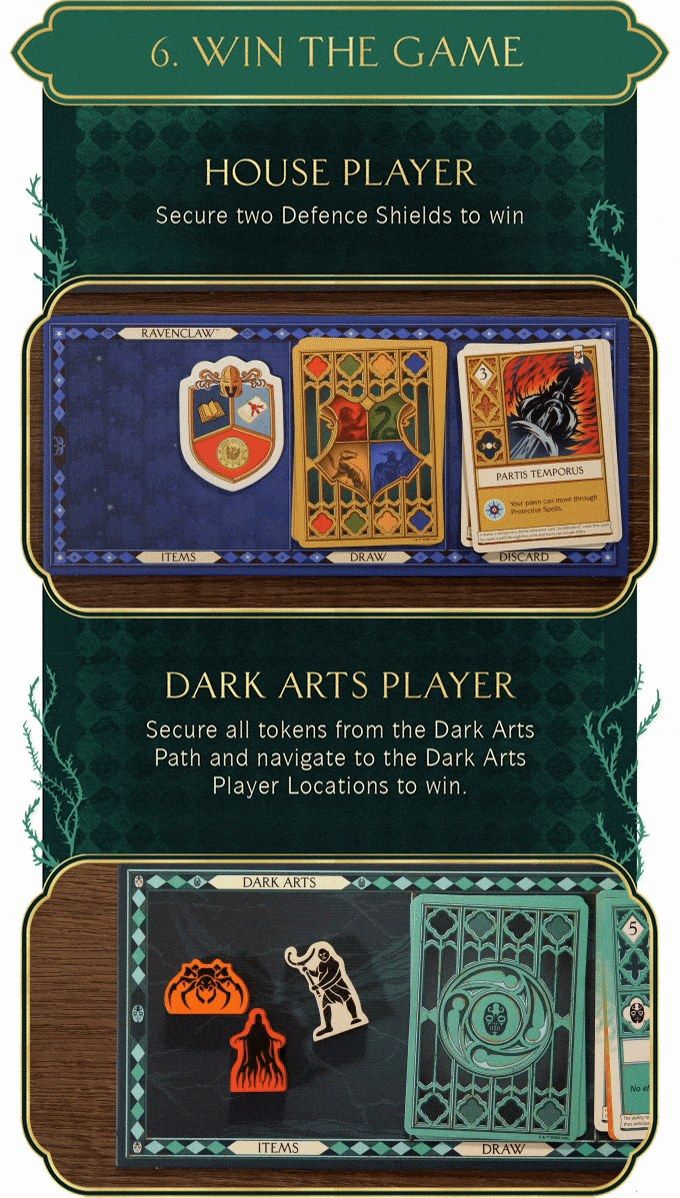
- A House Player collects 2 Defence Shields and wins.
- The Dark Arts Player gets the required number of pawns onto the Dark Arts Player Location and wins.
- Every hand plays out with nobody having finished their goal — the game is a draw.
Card effects and draw spaces are the stated exception: the no-Replenish lock does not apply to them [official, p. 22].
How difficulty scales with player count
The marker advances once per House Replenish no matter how many defenders sit at the table, so a five-player game generates far more Replenishes — and therefore marker steps — per round than a duel [our analysis, from the official rule]. Player count also sets the Dark Arts Player’s raw force: 4 pawns against one House Player, rising to 7 against four, with only 4 deployed at the start and the rest waiting in the pool to be deployed [official, p. 6]. More defenders also means more House Markers to collect for the all-markers path advance — harder to earn, but once earned it is the same single space.
One Board Family’s review observed that “the game felt really well balanced at three players as both sides fought to accomplish their end game tasks” — and that “the more often House players replenish, the stronger the enemy gets.” (One Board Family)
Watch the path explained
Chapter deep links into the official MinaLima how-to-play video (timestamps verified against the video’s chapter markers on 2026-10-13):
Sources
Official rulebook PDF, MinaLima — side board set up p. 7, bump and House Markers p. 21, Dark Arts Path and events p. 22, end game and draw p. 23: media.minalima.com — Defenders of Hogwarts rulebook. Difficulty-at-three-players observation: One Board Family review. Video and chapter timestamps: MinaLima Design, “How to Play: Defenders of Hogwarts ⚡️”.