Rules
Movement: the four barriers
Data last checked: · how we verify numbers
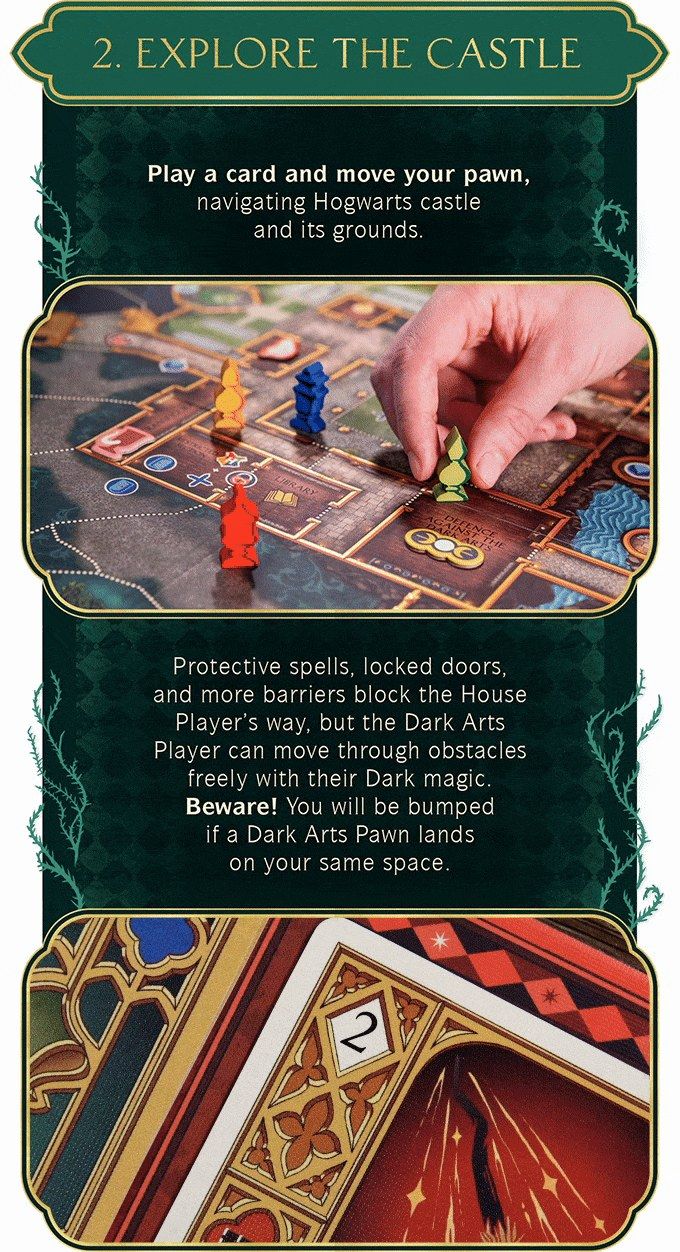
Pawns in Defenders of Hogwarts only ever move when you play a card: the card’s move value is how many spaces that pawn may travel [official, p. 10]. House pawns face four barrier types — locked doors, physical objects, water and protective spells — each passable only with the card family built for it, while Dark Arts pawns cross all four freely [official, p. 10].
How a pawn actually moves
Movement rides entirely on the Explore action, which everyone shares: play 1 card, then resolve its move and/or its effect in whichever order you like — the choice is yours [official, p. 16]. The rules on the card’s corner [official, p. 10, p. 16]:
- A single movement value — e.g. 4: move one non-stunned pawn up to 4 spaces.
- A multi-move value (two values) — e.g. 3 + 3: move two pawns 3 spaces each, or one pawn up to 6 in total. No other split is allowed: one pawn cannot get 2 spaces and the other 4. When moving two pawns, you choose which value to resolve first.
- You need not spend every point — unused movement is simply lost.
- No backtracking — you cannot cross a space you already crossed this turn, and you cannot end the move on the space the pawn started in.
- One space means a fully adjacent space: a space sharing a complete border with the one you leave.
A stunned pawn — lying sideways — cannot move at all, by card value or card effect, until a Replenish stands it up [official, p. 16]. House pawns may pass through and stop on spaces held by other House pawns, so friendly traffic jams are legal [official, p. 10]. If this all sounds new, the full turn sits in our turn-structure page.
The four barriers — and the cards that pass them
Four obstacle types block movement between some spaces: Locked Doors, Protective Spells, Physical Objects and Water [official, p. 10]. House pawns cannot pass any of them without a card that explicitly allows it [official, p. 10] — and note the rulebook’s own warning that card effects overrule the normal rules, so a whole-turn effect such as “can move through X obstacle” opens that barrier for everything else you do that turn [official, p. 16].
Each barrier has a named counter-card, and all four live in the identical 7-card starter deck every House begins with [official, p. 13]:
| Obstacle | Pass it with | Card family | Also verified |
|---|---|---|---|
| Locked Doors | Alohomora (move 3) | Charms | Filch’s Keys (move 2 + 2), from the Acquire Deck |
| Water | Gillyweed (move 3) | Herbology | — |
| Physical Objects | Strengthening Solution (move 3) | Potions | — |
| Protective Spells | Partis Temporus (move 3) | Defence Against the Dark Arts | — |
That 4-barriers, 4-cards symmetry is clearly deliberate design: which barrier stops you depends on whether the matching card is still in your hand or already in your Discard Pile [our analysis].
Secret passageways
The board carries 3 secret passageways, colour-coded red, green and blue [official, p. 10, p. 24]. Each one links two non-adjacent spaces, marked at both ends with the same colour icon, and a few cards carry the “Secret Passageway — All” ability instead of a single colour [official, p. 24]. Four rules make them House-only territory [official, p. 10]:
- Only House Player pawns may use them — the Dark Arts Player cannot.
- Only a specific card effect that allows it opens a passageway; seeing the icon on the map is not permission to hop in.
- You travel from your current space to the passageway’s other end in one hop.
- The hop costs 1 movement point off the card’s move value.
Fly-Off-Points
Fly-Off-Points work for everyone. Any pawn — House or Dark Arts — can fly from 1 Fly-Off-Point to any other, if the player has a card effect that allows it, and the flight itself costs no movement points at all [official, p. 10]. The School Broomstick in the House starter deck (move 2) and the Nimbus 2001 in the Dark Arts starter deck both carry exactly this “move from a Fly-Off-Point to any other” effect [official, p. 13]. Icons distinguish Fly-Off-Points inside the castle from those on the grounds [official, p. 24].
Protected Areas: the hiding spots
Four spaces on the main board bear the blue shield icon of a Protected Area, and Dark Arts pawns can never pass through one or end a move in one [official, p. 10]. That makes them the only truly safe squares on the map: the rulebook’s own example notes a player inside Hagrid’s Hut cannot be bumped, and reviewers confirm the “hiding” tactic this enables [second-hand — One Board Family review]. Being hidden costs tempo, though — every action spent lurking is one not spent collecting shield items (see Defence shields: how to win).
Walls and dotted lines
White dotted lines are the ordinary borders between spaces; red dotted lines mark the entrances and exits of Hogwarts Castle; and the castle walls themselves are a hard boundary nobody crosses — House or Dark Arts [official, p. 10].
Rulebook check
The rulebook defines adjacency twice, slightly differently: p. 10 says one space means “a space that shares a full border”, while the glossary (p. 25) says adjacent spaces share “a white or red dotted line”. The practical reading reconciles them: the dotted lines are the borders — white for ordinary adjacency, red for castle doors — and the walls are simply not a border you may cross. Both wordings agree that a “wall” edge blocks movement for everyone [official, both; our practical reading].
How the Dark Arts player moves differently
The Dark Arts Player’s pawns run on the same card-driven Explore action, but the map treats them very differently [official, p. 10, p. 20]:
- Obstacles
- Dark Arts pawns move freely through all four — locked doors, protective spells, physical objects, water. No card needed.
- Protected Areas
- Absolute no: a Dark Arts pawn can neither pass through nor end its move in one.
- Secret passageways
- House-only — the Dark Arts Player cannot use them, with any card.
- Castle walls
- Still impassable; the walls bind both sides.
- Fly-Off-Points
- Usable, same as House pawns — with a card effect such as the starter’s Nimbus 2001.
- Deployment
- An off-board pawn joins the map by spending 1 movement point, placed on an unoccupied Deployment Space (the Dark Mask icon) — a space already holding a Dark Arts pawn, even a stunned one, cannot receive another.
That 1-point deployment price is a real tax: every bumped Dark Arts pawn returns to the pool and must pay its way back in. For the full turn and unlock system behind these pawns, see Dark Arts player guide.
Watch it explained
The official MinaLima how-to-play video demonstrates Explore and its movement rules; timestamps verified against the video’s chapter markers on 2026-10-13:
Sources
Official rulebook PDF, MinaLima — movement and map elements p. 10, cards and movement values p. 13–16, stunning p. 16, Dark Arts turn p. 20, icons p. 24, glossary p. 25–29: media.minalima.com — Defenders of Hogwarts rulebook. Video and chapter timestamps: MinaLima Design, “How to Play: Defenders of Hogwarts ⚡️”. Hiding-tactics reading: One Board Family review [second-hand].